How Claude weighs a single death
No single piece of evidence in this case answers the question “who killed” in full. Each covers its own part, and the strength of a conclusion depends on how many parts converge.
Dozens of recordings have been aligned to a single clock. If an officer fires at the same second a person falls, that is a strong link. Video does not show where the bullet goes.
The wound track and how the person was standing give the direction. If only the Maidan is behind and only the security forces are in front, the direction almost settles the matter. A ricochet or an unknown posture undermines it.
Only a bullet ties a death to a specific weapon: the expert examination compares the rifling marks with reference test-firings of the rifles. It is the only way to name not just a side but a specific gun.
Here is how this works for three deaths from the same morning. In the first, all three lines converge; in the second, they point to the Maidan side; in the third, they do not converge at all.
Roman Varenytsia09:46:22 · at Arkada
- ✓Video
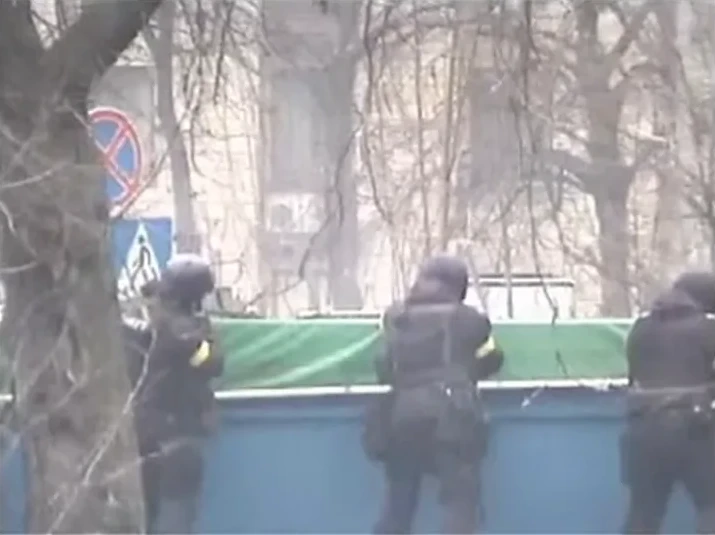
- Smoke from a shot by the “second from the left” on the concrete barricade, one frame before the hit.
- ✓Wound
- The bullet passed through a tree and a shield; the hole in the tree points toward the blocks, and the trajectory matches both wound tracks.
- ✓Bullet
- From a special company rifle. According to the court’s finding, the same rifle had wounded a member of the evacuation team a minute and a half earlier.
Volodymyr Zherebnyi09:44:44 · at Arkada
- ◐Video
- His posture at the moment he was hit is visible. In the same minute, the barricade was also firing at the area.
- ✓Wound
- Entry on the left, the wound track runs steeply downward, no obstacle. Court: the shot came from the direction of the hotel; the barricade version is “спростована” (refuted).
- —Bullet
- No link to a specific weapon.
Bohdan Vaida09:00:37 · at the water cannon
- ◐Video
- Retreating security forces fired pump-action shotguns nearby about a minute earlier. The shot itself is not visible.
- ◐Wound
- Buckshot to the temple from behind and to the left, heavily deformed. A ricochet off the water cannon’s cab is not ruled out; the cab may have been fired at from the protesters’ side.
- —Bullet
- Buckshot cannot be linked to a specific shotgun.
That is why ballistics matters so much here. In 12 of the 48 deaths, a bullet from the victim’s body or clothing matched a special company rifle (in two cases it was found in the clothing; in three, the rifle was assigned to an officer who was not at the scene at the time, so someone else fired it).
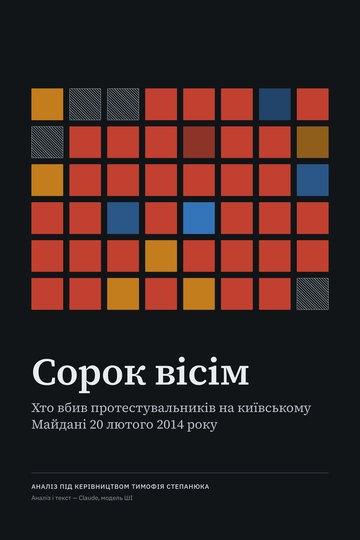
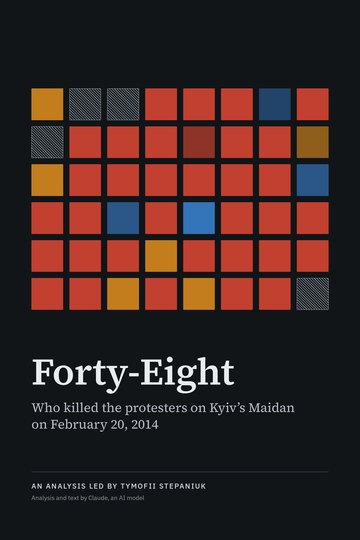
Each square is one of the dead, in order of time of death. Red with a dot: a bullet from the body matched a special company rifle.
This evidence base has weak points, and Katchanovski targets exactly those. Some physical evidence was lost or excluded, the special company’s rifles were sawn apart, and the chain of custody of a number of bullets is questionable. That is why, even in episodes with direct ballistic evidence, Claude’s estimate for the special company goes no higher than 92%. In the remaining 36 cases, the conclusion rests on video, wounds and the court’s group findings: the court attributed a death to the special company together with other security forces if the shot came from their area during the minutes they were firing.
Who fired from where
Both sides fired that morning. The street profile marks the places shots were fired from, based on the case record: blue for the Maidan side, red and orange for security forces. For each, it shows what is known and how firmly.
Maidan side
- 1Conservatory, 05:30–09:00Video: shots “із-за колон Консерваторії в бік правоохоронців” (from behind the columns of the Conservatory in the direction of law enforcement officers). The court considered fire at security forces from 5:30 proven (the Conservatory being one of the sources): by 9:00, three had been killed and 39 wounded.
- 2Barricades near the Stela, morningVideo: security forces fired on with buckshot; a man loads a hunting shotgun at 08:37.
- 3Steps and footbridge, 09:06–09:16Four shooters with shotguns and a pistol. Shots by one of them coincided in time with the wounding of two special company officers, one of whom died.
- 4Armed men in groups in the alley, 09:16–09:30At least three armed men move up the street; at 09:24 a man “стріляє з мисливської рушниці в бік правоохоронців через спини активістів” (fires a hunting shotgun towards law enforcement officers over the backs of the activists).
- 5Hotel Ukraina, morningCourt: there were armed people in the hotel; shots were fired from room 1116 toward the barricades, time unknown. The hotel direction figures in the deaths of Ushnevych and Zherebnyi.
Security forces
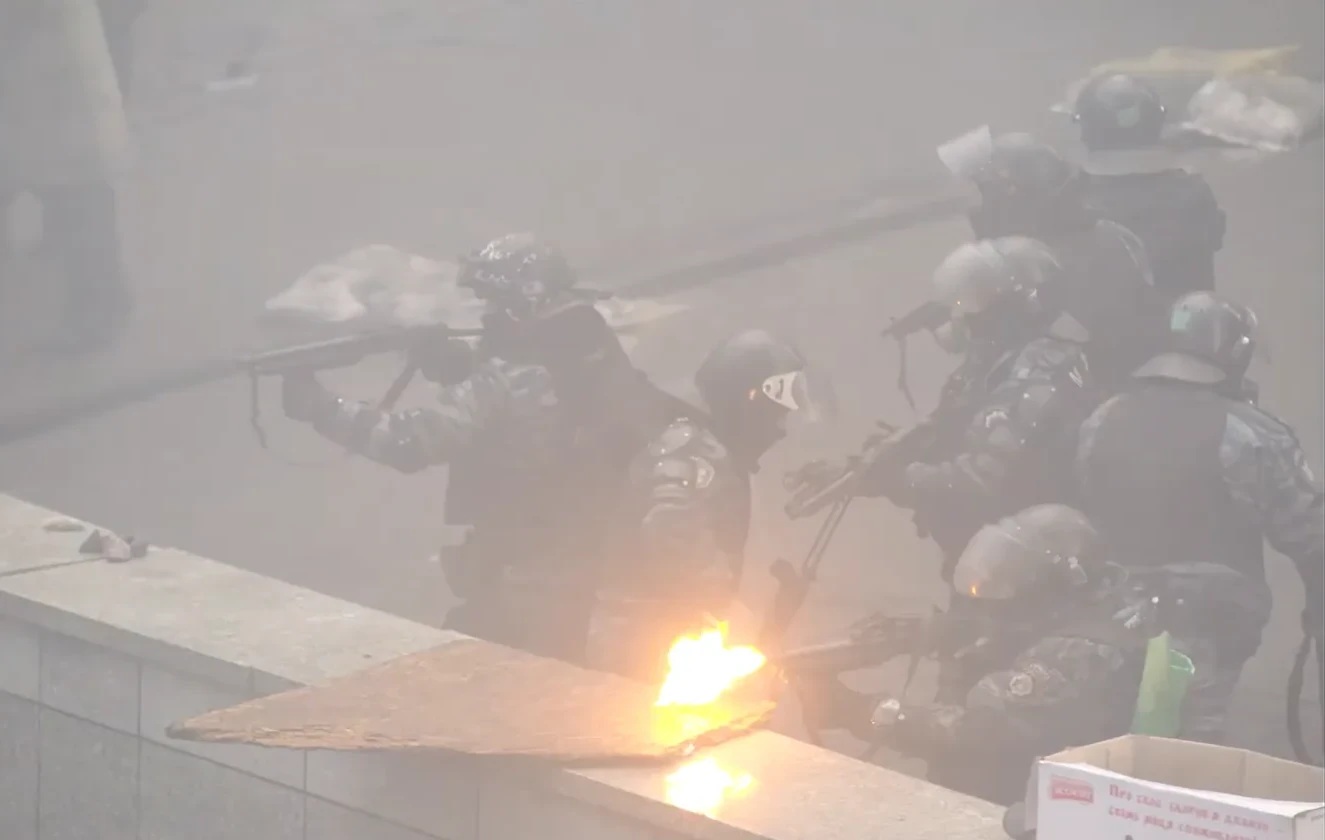
- AGroup with green markings, 08:55–09:1217 officers fire from behind the parapet, almost all with pump-action shotguns; the court established that this group fired the shot that hit Arutiunian.
- BSpecial company at the palace, 09:03–09:16Rifle fire on the orders of the deputy regiment commander. The court attributed four deaths before 09:17 to him personally, as caused by negligence.
- CSnow barricade, 09:20–09:30Special company and men in black without armbands, some of them with sniper rifles.
- DConcrete barricade, from 09:30Special company, attached snipers and a machine gunner, an Internal Troops detachment. 5.45 and 7.62×54R cartridge cases were found, not only from special company rifles.
- EGovernment quarter, after 11:00The main Omega unit at the Cabinet of Ministers club. On the club’s 2nd-floor windowsills there are marks of rifle rests; who stood there and when has not been established. A 2018 examination ordered by the investigation linked a fragment of the bullet that killed Khrapachenko to the rifle of one of the Omega snipers; it was not tested in court.
How many lives fire from the Maidan side may have taken
The court did not identify any of the shooters on the Maidan side by name. It describes them in terms of groups and roles, and notes that shots at security forces “взагалі ніяк не коментувалися” (were not commented on at all) from the stage and that there was no control over the armed forward groups.
In Claude’s estimate, this fire most likely took the lives of about nine of the 48 protesters, with a reasonable range of 5 to 16. About three of these nine come from four episodes where the Maidan side is more likely, about two from four “too close to call” episodes, and the rest is spread in small shares across other episodes. About 5.4 of the nine are backed by direct indicators of shooting from the Maidan side; the rest is a margin for possible errors in the expert examinations.
A more important question is whether these were accidental hits or deliberate shots at their own people. The shooter’s intent has not been established in any episode. If these nine deaths are distributed among the most likely mechanisms, the result is:
In no episode does the last of these mechanisms get more than half: the highest is Zherebnyi’s, at 46%. Claude puts the probability that at least one such killing took place in a wide range: from 46 to 91%.
If such shots were fired, who could have been behind them? None of the versions rests on an identified shooter, so these are shares of a single uncertainty, not findings.
Who ordered the security forces to shoot to kill
Who fired is one question. Who ordered the firing is another. The court traced the chain of orders, and there is a gap in it.
- since 2015President → minister and heads of the security agencies → Kyiv police headquarters (MVS Main Directorate) → regiment commander → special company
This is the chain as set out by the prosecution. No court has examined it on the merits.
claimed by the prosecution - February 18The Minister of Internal Affairs, the head of the SBU (Security Service of Ukraine) and others decide to use their authority to employ weapons
This concerns the powers of security forces in general, not the shooting on February 20.
proven by the court - February 18, around 16:00The regiment commander, “on the instructions of the leadership,” orders the special company to be armed
The verdict does not say who exactly in the leadership gave the instruction, or what it was.
proven by the court
- February 20, around 09:05Deputy regiment commander: indiscriminate rifle fire
According to the court’s finding, he made the decision himself: the goal was to get the security forces out of the palace; the method was “явно злочинний” (manifestly criminal).
proven by the court - around 09:17He and the special company commander: fire “на ураження” (to hit) at a crowd of people
After an officer of the company was killed. The firing continued even as people were withdrawing with the wounded.
proven by the court
The regiment commander and the special company commander were later convicted in absentia, but for removing and destroying weapons, not for the shooting on February 20; their cases over the shooting have not been decided. The finding about the 09:17 order with respect to the special company commander was made in someone else’s trial, in which he had no defense.
Where Katchanovski is right and where his version does not hold up
The book’s thesis can be tested with a number. He claims that shooters on the Maidan side killed most or almost all of the dead; out of the 48 deaths on February 20, that means 25 or more. Below is what the case record yields, on the same scale.
That is why Claude puts the probability of the book’s full thesis at under 3%. But some of its arguments are correct.
Supported
- There was shooting from the Maidan side. On February 20, in Claude’s estimate, it was from there that fire to hit people was opened first: from 5:30, at security forces (the court itself considered this fire proven).
- The court itself pointed to Hotel Ukraina in two deaths, did not rule it out in a third (Pekhenko), and in Melnychuk’s case acknowledged that an aimed shot was possible only from there.
- The investigation did little ballistic analysis of shot directions, some evidence was lost, and the rifles were destroyed.
- In six episodes, in Claude’s estimate, the Maidan side is no less likely than security forces.
Not supported
- In 12 deaths, the bullets matched special company rifles.
- In about ten deaths, the court used video to link a person’s fall to a shot by security forces in the same second; in six, on one and the same recording.
- Many of the “steep” wound tracks he relies on run differently in the expert examinations accepted by the court.
- Weapons that security forces “did not have” turn out to have been in their hands: the 7.62×54R cartridge fits the sniper rifle on the barricade.
How many deaths on which side
Adding up the estimates for all 48 episodes, and allowing for the evidence being wrong not piece by piece but in whole blocks, gives the following expected distribution. Under each number is the range the result falls into in 9 of 10 runs.
Each bar’s scale runs from 0 to 48 deaths. Because of rounding, the means need not add up to exactly 48.
And if the question is answered for each person separately, the picture is this:
≈28 is the sum of shares across all episodes; 34 is the number of people for whom the special company is the most likely version. The tile color shows the most likely side; the paler it is, the lower the confidence.
How solid this is
The verdict has not entered into force. Most deaths were attributed to the defendants through group findings, without a bullet tied to a specific body. The spread of results is driven mainly by two common risks: that the entire ballistic evidence base is wrong at once, and that all of the court’s group findings are wrong at once. You can enter your own values for these risks in the calculator in the dossier.
What remains open
- Whether the order to fire at people on February 20 came from above the regiment level.
- Who exactly fired from the Maidan side, where they stood and whom they were aiming at. The court did not name a single shooter.
- Which member of the group with green markings killed Heorhii Arutiunian. An indictment against the commander of the Sevastopol Berkut company and two of its officers was sent to court in October 2024; what has happened to it since is unknown.
- Twelve disputed episodes where the data are scarce or point in different directions.
Much would be settled by comparing the bullets from the bodies with activists’ weapons, by questioning people who were in the hotel and the Conservatory that morning, and by investigating the deaths of security officers, which, according to the court, have remained uninvestigated.